You may notice an air of confidence (over-confidence?) in what I post on this site. What makes me think I “know” all this? Who am I to propose a system of writing overlooked by every teacher and author of writing and rhetoric (in English, anyway) since Shakespeare’s days — and even before that?
I thought you’d never ask! Ever the gracious host, I will gladly share.
But first, let me lay out a few “bare facts,” as readers expect under a tab like “About So-and-So“”
> Born and raised: May, 1958, fourth of six siblings born to Enrico and Kathleen (Kavanagh) Zizzi, and grew up in Apalachin, NY
> Education: Ph.D., Communication, University of Colorado — 2011 / M.A., Speech Communication, University of Maryland (graduate fellow) — 1989 / BA: State University of New York — College at Oswego, summa cum laude) — 1987 / Broome Community College — 1984-85 / University of Colorado — 1976-77 / High School (cum laude), Vestal Central High School, Vestal, NY — 1976
> Employment (major employers): Storage Technology Corp, Louisville, CO – 1980-84 / Regis University — 1989-2019 / University of Colorado — 2005-2021
> Personal: Residence: Golden, CO — 1993-present (32 years at same address!) / Family: divorced with two adults sons, Adam and Burke / Community Service: head coach for more than a dozen youth baseball teams / VP of neighborhood homeowners “coalition” board / volunteer musician/performer 20+ years at formal (and informal) neighborhood events — writing original songs, playing bass, and singing.
————————————
Okay, there’s the resume; now, for the narrative. Grab a drink (of organic tea, of course), and sit back. I will gladly and gratefully present a brief-(er!) look at the background and experience that put me in the perfect place to believe that I can (with your help) open your eyes and keyboard to a new way of thinking about everything you write, hence to open up your personal, natural, thereby authentic, writer’s voice — making the whole planet nicer for everyone. That’s my story, and I’m sticking to it.
Nobody needs more of what has already been said — a lot
You might call that my thesis statement — the central point of this whole site. Rather, what we need — not just for smoother relations and productivity, but for the enrichment of our humanity — is your voice, saying things that only you could say, your way.
To understand “about Mike” requires that you understand this “thesis statement,” my core belief that drives and centers my work: Nobody else has lived your life, knows what you know, can speak with your vocabulary and “way with words,” and is involved in what (and whom) you’re involved in.
Well, it’s true of me, too, so if/when you read things you’re not used to seeing, you’ll recognize that (for any possible offense taken) at least I’m practicing what I preach. So allow me to share the basis of my preaching, all proper thanks sent upward.
As you will read below, I gratefully credit three pretty special sources for helping me into a position to present an original and voluminously proven re-thinking of how we write — and even how we think — in words. For those only marginally interested in “how I came to know all this,” I’ll first present a relatively brief version (aka, “the Skinny”). If you enjoy that and/or want to know more, you can then read the longer (more autobiographical) version, to follow. But, as my mom liked to say, first things first:
The skinny
Let’s start with the short (for me!) version of my basis for writing on this site with an attitude that is not only confident in what I teach, but likewise confident in the various critical commentary you’ll find aplenty on this site.
Indeed, you will find, here on Up-Wordz.com, abundant commentary (aka critique) as regards certain “trendy” beliefs and practices in present-day writing. And you’ll find plenty more of my critical perspective within the “soup” of communication topics (the sub-menus under the front-page menu, Comm Soup), including driving in traffic!
And, yes, I have thoroughly researched and written (a lot!) about “driving as communication” (more specifically, driving as “rhetoric“). That’s just a little bonus on this site, along with the writing lessons and related “comm” commentary.
First, I was born in the broad swath of Upstate New York known as the “Southern Tier,” with its informal capital, Binghamton, a dozen or so miles to the east, along the area’s main geologic feature, the Susquehanna River. There and thereabouts, I was born into (by genetics and upbringing) a lifelong love and aptitude for writing and speaking in the English language.
Both of my maternal grandparents earned significant respect (locally and statewide) for their contributions to the teaching of English and speech. Not just “English teachers,” they made their marks as honored leaders in speech, debate, and the humanities.
For example, my Grandpa Jim (James P. Kavanagh) served, throughout the 1940s and into the ’50s, as president of the New York State Speech Association (not to mention serving as president and faculty representative of the teachers’ association in Binghamton Central School District — the largest district in our region of the state), before dying prematurely (in his 50s) of heart failure.
Similarly, my grandmother — (aka”Gram,” aka Elsie (Waters) Kavanagh — frequently made the newspapers. (I’ve inherited the family “box of press clippings” about them both, so I have the proof!) And Gram etched her name forever in the folklore of Vestal Central Schools, coaching championship debate teams, directing, for many years, the school’s annual stage production, including musicals (a big deal at a high school graduating 1500-2000 seniors each year), and proudly winning (mid-1960s) a summer fellowship in writing and the humanities at prestigious Bennington College in Vermont.
As with everything in this “brief” narrative, you can find further details about my nature-nurture heritage in the second, more autobiographcal, version of “About Mike” that follows this quicker read.
“Back to school” (after seven years!) with a bang!
Secondly, my formal education in communication (aka “comm”) features not just a batch of 4.0 semesters – across 13 years, total, of full-time collegiate study – but also lots of writing recognition and other college distinctions and awards, from campus-wide to national, as well as writing and editing positions on several college newspapers and literary magazines. It’s a theme of my life: wherever I go, I end up the editor of their newsletter — or more.
This college-journalist life includes the totally fun role as sports editor (and reporter and photographer) my first year “back to school” at Broome Community College, where I wrapped up a surprisingly eventful year there (while living with my dad, RIP — such cherished memories) by winning the school’s annual writing contest and also seeing one of my sports photos (baseball) making it into the Sunday edition of the city paper (not school newspaper), as a trade for their photo lab developing and printing several close-up B&W shots I’d taken of musician and guru Carlos Santana. (I’d snuck into the Arena, under my jacket, the school camera, with its foot-long lens!)
Two likewise-eventful years later at Oswego (including writing and editing roles, once again, on the student newspaper and also the school’s literary magazine and elsewhere) . . . and it’s graduation weekend at SUNY-Oswego (May, ’87), where I’d become a columnist, poet, and all-’round star student. Among a couple dozen graduates honored at awards night, only one awardee got to hear, “and with a perfect GPA of 4.0 . . .“! My dad gasped out loud. I had the only 4.0 in my graduating class of about 1600. Yes, RIP, Dad. I know that was a special moment for you, and that makes it all the more precious to me.
Just months thereafter, the very first paper I wrote, for my master’s studies at the University of Maryland (MA, ’89) took first place in a national contest for graduate research. They were paying me to study there (on a two-year fellowship), so I needed to do well. That award, earned with my very first major paper, made for a good start. Even better, the faculty decided they needed to get me into a classroom (as required of “teaching assistants” but not graduate fellows), and, just my second semester there, they added teaching duties to my fellowship, extra pay and all. And my teaching career took flight.
In fact, every one of my nine (!) full-time years of graduate study came without a tuition bill, but with a paycheck, since I held either a fellowship, assistantship, or both. I wrote lots of papers that made news, and I studied closely under several of the world’s (!) biggest names in my field, ultimately theorizing “dialogue in teaching and learning” in a 415-page dissertation, thereby earning my doctorate (University of Colorado, 2011) in the same field as my master’s and bachelor’s: communication.
Between my genetics and upbringing, then an academic history like that, you’d feel confident, too, in rendering views and analysis on issues related to communication and language. But wait! There’s more.
Mike sets a teaching record — and builds a department
Along with my upbringing and formal education, I thirdly count, as foundational, my unbelievable (at least, to me, looking back) record of university instruction and leadership, including not just a massive teaching record but also initiating, developing from scratch, and leading into robust health, at Regis University in Denver) a university department in my beloved field of communication.
In this “short version” of my basis for putting up this site, please allow me to repeat a momentous but relevant brag: I, personally, have taught more university-level course sections than any faculty member, in any major, at any school, in the history of higher education in my adopted home state of Colorado – possibly in the nation! (That last one’s hard to verify, so let’s call it a maybe.)
Many factors go into that, such as seeing past the relatively low pay (offset, some, by the high volume of work) and the ability to consistently pack the classroom, meaning the teacher/prof is making the school a lot of money. Boy, did I make a lot of money for the schools who that were kind enough to put me in front of one group after another, and, for many years, four classes at the same time.
Including almost 300 classes (mostly in communication and mostly to adults) taught for Denver’s Regis University and 100+ classes taught (mostly writing and rhetoric) at the University of Colorado, across 32 very busy years, I have gained a boatload (and don’t go thinking Titanic, ha ha) of relevant teaching experience, not just in the classroom but also at home, grading, by hand, approximately 40,000 papers and speeches.
Just as significantly, that’s a heck of a lot of groups (human beings, in a group!) organized, curated, and taught – and each group a “creature” of its own. For many reasons (suggested by the fact that I could even get all that work!), I just went out and owned the record book, in my state and beyond. I lived to teach (still do), and my students appreciated that and thrived, in class and many times publicly.
We need a Comm dep’t around here!
Yes, it’s true that, that, during my first decade (of 30+ years) at Denver’s Regis University, I initiated, through numerous committees, then led into viability and even prominence (with lots of help, of course), a real-life communication department! Aided by a dedicated and talented team of star players — in fact, almost all women, as I think back — I made my dream a reality. The huge adult program at Regis (six times the size of Regis’ traditional college) offered no “major” in communication — and then it did — with yours truly at the helm.
In doing so, I enjoyed enormous freedom, and I became well known everywhere I went on campus. And I went everywhere. One year, I even led the faculty procession at graduation — that kind of thing. The courses I thought we should develop and offer, we promptly built, staffed, and rocked! Any prospective faculty applicant I liked a lot, I could hire, almost on the spot. I was the search committee and held the deciding vote. That’s really rare in academia, which likes to bog down, by committee, every decision.
Our classes frequently overfilled, requiring new sections added during registration, meaning more classes for everybody, leading to a very happy and motivated faculty to lead. Our adult-program faculty roll included about 800 members (maybe 100 super–regulars — who taught multiple sections, every fall, spring, and summer — and this ginormous faculty elected me to represent them as the sole voting faculty representative on our Academic Council, the same body that had approved, the year before, the “new communication major,” which I would build and lead.
Thusly, I was able to architect and build a theory-rich, successful, and noticeably profitable communication department. The “noticeably profitable” part (which happened immediately!) explains the unusual power I held, and I emphasize the theory-rich part, because that’s sometimes missing in academic departments, especially in the social sciences, communication included. I brought enough theory for everybody and shared a lot of it with my awesome stable of about a dozen star teachers. And this came some 20 years prior to studying for my doctorate!
We didn’t “make ourselves”
These three life-phases – upbringing, education, and teaching career – did produce a pretty deep and also broad knowledge of my field of communication, especially as regards language and writing. I rarely, if ever, meet a fellow scholar with “all three degrees” (BA, MA, PhD) in communication, though I’m sure some are out there. I’ve shown a lot of commitment to my field – and to my students.
Thanks to abundant gifts from above (as I like to say, “I didn’t make myself“) and endless gifts of love and support, from family — along with gifts of opportunity from faculty, management, and peers — I have gained some special expertise in my field of communication, including writing, which I want to share, on this site, with you.
Believe it or not, that’s the “short version” of why I write what I write with a distinct air of confidence. If “that was plenty,” feel free to move onto the other places on this website – especially the writing lessons, the heart of this site. You will need to register to see the writing lessons. I want to know who my “star students are.”
You can even send me a message, if you’d like, via the “Contact Mike” menu/tab at the top of the site. I am known to write back.
On the other hand, if you care to peruse further *relevant* (to this website) biographical highlights (sorry, but the “love-life tell-all” comes only in the hardcover edition!), below, you can indulge in a healthy serving that’s definitely not for those counting calories. You’ve had the appetizer. Maybe come back for the entree? It’s up to you.
I’m just pleased that the unusual doings of my life now have a textual home. Very little in my life story (especially related to my present goals) could qualify as normal. Munch away as you prefer.
— — — — — — — — —
Now, for the indulgent details
I’m not sure who (if anyone) needs or even wants to read all this, but I think some reasonable readers might like to know more about where I “get off,” claiming the right to “reformulate” major understandings of English grammar and structure – and the teaching of these – and also to criticize not just the teaching, but also some of our currently “trendy” practices in how we speak and write.
When you tell the world, “The ten thousand prior books and the one million ‘English teachers’ out there have all left out the most important thing,” then I think you need to let people know that you didn’t just dream up all this, sitting alone in a treefort, like the Unabomber, imagining that by some divine grace, you just happen to know better than everyone else.
Alas, it’s true that “boastfulness,” regardless of the ‘fabulous feat’ relayed, usually works more as a turn-off than a credibility builder. Then again, “usually” shouldn’t be confused for “always.” I’m hoping that you’ll actually find some value in what follows, as I lay out certain relevant (to this site and my goals for it) events and achievements that, in their unique combination, helped pave the way for me to come up with this new way of thinking about — and writing — sentences, something you’ve done all your life!
Somehow, you’ve “managed just fine” (sometimes!) without me and my “activated” writing system. Boy, that bothers me!
Just kidding. Truth is, I’m proud of you for making it to my site. It’s different, often weird, sometimes obnoxious, but alway provocative — and . . . it says a lot about you that you’re reading this.
I hope you understand that I don’t spew marketing horseshit, like “Pay ten times more for this tiny bottle of whatever . . . because you’re ‘worth’ it!” I laugh when I hear that that utterly empty crap coming out of my TV, and I say to myself, “If the people rich enough to afford that are also stupid enough to buy it, then there is a fairness to that.”
But some dismay lingers in my conscience. It really does “bother me” to know that some people are gullible enough to not immediately despise (or at least boycott) any company who can make no more legitimate argument than “YOU (everybody out there) are the special one, so you ‘deserve’ our overpriced product. For someone as ‘special‘ as you (whoever you are) — no amount of money is too much to spend on your obviously ‘deserving‘ self.”
Well, in contrast, dear reader (and prospective Reader-student — I can’t call you that until you start reading and studying my actual “writing lessons“), you are not just someone whose face happened to be aimed at your phone when my pop-up ad assaulted your intelligence by calling you (and every other viewer) “the special one.”
You (unlike the “unworthy masses” who will never see this!), acting on your own free will, actually clicked your way to this site — with a marketing-indifferent and “book-like” (yuck! say the masses) ton of text in front of you. You made it here, and you are still reading. You have actually done something to deserve praise. I appreciate you!
With good reason, not marketing slime, I do praise you and desire to teach you — for free — a system that will open many doors for you, especially the door to your own authentic self — as expressed, to and for others.
So back to the shameless bragging. Big house, big car, big boat — I don’t have much, if any, of that to brag about. Nor did I ever desire any of that. What I wanted — and made happen — is life of rich experience and deep impact on others, helping them to achieve (and maybe even upgrade, more altruistically than materially) their own dreams. I have done a lot of that.
So here’s my final warning: You can jump ship right now and go straight to Writing Lessons or any other of the menus and submenus that I’ve put up for you (with much help from my son). But, if you’re enjoying my style, grab some popcorn, and read on! If nothing else, you’ll get some writing that shows you the very thing I want to teach you: don’t try to sound acceptable, sound like you!
A “Gram” of learning goes a long way
During my upbringing in Apalachin, NY (schooled in nearby Vestal), my locally famous (as a news-making teacher in English and the humanities) and much-loved grandmother, Elsie Kavanagh, mightily influenced my connection with language, from childhood through adulthood — right up to her passing.
For as long as I can remember, Gram always lived near-by, at one point right next door to us and at another point living right there with us in our family home. From kindergarten through my first go at grad school (at the Univ. of Maryland, for my master’s), my life came with a built-in “tutor” of English, writing, and speech – not to mention a very worthy partner in debate. And, from the cradle, I enjoyed an enlightening role model as a teacher.
As certain siblings and cousins can attest, rarely did any paper of ours (if we lived close-enough by, and I always did) make it to our teachers’ eyes before Gram had reviewed it — not just to make corrections and improvements, but to use it as a teaching tool for the next assignment. Our Gram didn’t just “proofread” our papers; she dismantled them. Then, with our “help,” possibly following the shedding of a few tears (and I don’t mean hers), the papers would become transformed into “essays,” to bring out and highlight the best in what we had brought to her. We loved it. Kinda.
“There, Michael. See how the transitions pull together the essay, while staying close to the thesis?” “Uh- I couldn’t have said it better, myself, Gram.” “Don’t get smart with me.”
And Gram didn’t stop with grammar. Even our pronunciation and enunciation (not the same thing!) received reliable and steady critique: “It’s not ‘err,’ like “air.” You must say “err,” rhymes with her! Say it three times: Er, er, er.”)
“Er, Er, Er. Now, are we *gonna* play gin-rummy?”
She’d correct, “Are we going to play gin rummy?” Not to let her down, I’d reply with the predictable (in our family) wise-guy comeback,”I asked you first! Are we gonna play or not?”
Again, she would make a face and pretend disapproval. She knew we were learning, and she loved it. As long as I properly *enunciated* “going to” the next few times, I wouldn’t have to hear about it again – at least not that night.
Every word, a jewel
At one point in her career, she even — like her departed husband had gloriously done, before her, coached her high school debate team, as I heard about now and then, and every story came with a clear-cut lesson, moral, or warning.
The study of rhetoric definitely started early in my life. Gram would tell my about my long-departed Grandpa Jim, and how his debate team had presented him with a plaque bearing his famous motto: Every Word A Jewel. When she died, I inherited the plaque and cherish it to this day; in fact it’s in view as I write this from my kitchen table. I think I’ll take a pic.
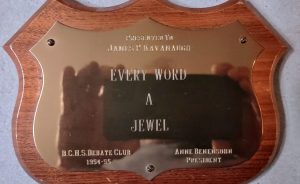
This treasured heirloom has inspired me for longer than I can remember. The plaque was presented to my grandfather, the aforementioned James P. Kavanagh, by his very successful debate team at Binghamton (NY) Central High School, in 1955. That makes the plaque three years older than I am — in other words, an antique!
Added: And by the way, I just learned from my sister, Jamie, that David Rossie — famed Binghamton native and newspaper columnist (Pulitzer Prize finalist in 1983, I just read on my phone; pays to always check your facts!) in the Binghamton Press and Press & Sun-Bulletin — once wrote a column about my Grandpa Jim, thanking Grandpa for his success as a writer and journalist. The column focused, especially, on my grandpa’s well-known (at Binghamton Central High School and elsewhere) motto, seen above. Pretty cool.
Along with stories from the debate floor, Gram would impart her teaching philosophies and practices. These stories laid for me an early and stalwart foundation for learning how to teach – whether striving to channel difficult students into productivity or channeling the fastest learners into stardom. Gram taught it, and I did my best to learn it. I’m proud to share that a great many “someday students” of mine (that was her goal for me, and she lived to see it — yay!) owe to her a majority of the thanks that, over the decades, they’ve kindly shared with me. I’d sometimes say it: “You can thank my Gram.”
What pride she eventually took in my career, which, indeed, came to emulated hers, except not in high school, but college, where, I too, found myself at one point coaching the debate team, as a fill-in Director of Forensics for Regis University’s traditional (college kids) program.
With no experience whatsoever in collegiate (nor even high school) debate, my one year as debate director, ended with my top two-person team (of three teams I brought to nationals) holding up the championship trophy at the season-ending “big dance” — Novice Nationals — for freshman debaters. (My whole squad had come in as freshmen!).
Unlike the “big Dance of NCAA basketball, our national tournament was not limited to a starting field of 68 teams — more like 200. Round at a time, the field shrunk by half, until two teams remained. To get there, I remember beating teams from Stanford, Princeton, Cal-Berkeley, and even Notre Dame!
But there were my top two debaters, there at the tournament’s finale, debating for the trophy in a huge and filled auditorium: Regis University (student body, 1200) against the host school, the University of Nebraska (student body, almost 30,000). With five (not the customary one) judges, we won on a 4-1 ballot, a “landslide” I was told. Remember this was my only year on the circuit!
You think that’s a shameless brag? Well, it is. But I can go one notch further. In the final–four of this tourney my Regis squad had placed not one two-person team, but two! That is, of the three teams I’d brought, two teams from my tiny, Jesuit school made it into the national tournament’s final four, including the team that won the trophy! Not bad for my only year coaching collegiate debate. If spirits in Heaven really can look down on the key moments of our lives, I’ll bet I had a pretty proud Gram and Grandpa looking down.
I’ve got the music in me
Some things do run in the family. As I have elaborated above, these traits include a natural affinity for language and teaching. Considering my own parents, not to mention siblings (I was born fourth of six kids), I can add a third in-born love, connected to the other two. I refer to the playing and teaching of music — and in my case, also writing it.
Many people in and around Ithaca, NY knew my mom, Kay Zizzi, as a fabulous singer, trained in opera (college scholarship for that) and busy her whole adult life on nightclub stages, where she earned the nickname, “the Carmen McRae of the Finger Lakes.” Sometimes I’ll tell new friends, “My mom was a beloved singer,” and they’ll say, “That’s nice.” Then I’ll put her on the stereo, and their mouths drop open. “Holy shit!”
Sad to say, she died of coronary failure at the young age of 47 — in fact, right on her way to a Friday night singing job in Ithaca, NY, where she proudly fronted a jazz combo, the Kay Zizzi Trio. I have lots of digitized songs. I’ll have to post a couple on here. If I do, then, to many, this site just got ten times more valuable!
Many know of my mom’s singing, but not as many know of her lifelong excellence in writing and language, starting in middle school, when she won a national essay competition, after making the finals the year before. She read books voraciously (our house overflowed with them), and she loved word puzzles, as I still do, myself. She took pride in being able to sing opera in several languages.
You might wonder, what kind of girl even enters national essay contests in “junior high”? I’ll give you a hint. Look at her parents. You’ve already read a bit about her mom (aka Gram); well, her dad (my long-deceased Grandpa Jim), had likewise earned a local and statewide reputation in speech.
Indeed, my grandfather, James P. Kavanagh, whose honorific plaque appears above, not only made it into the local papers regularly for his successful exploits teaching English and public speaking (including the success of his debate squad in Binghamton, NY), but he was elected and served (in the 1940s) as the president of the New York State Speech Association.
Nowadays, that role would be held by a prestigious university professor of speech. Back in the 1950s, those were hard to find, but the prominence of high school debate would make a highly successful debate coach and frequent public speaker a worthy candidate.
I couldn’t be prouder of that. Interestingly, he died quite young (in his mid-50s) almost exactly nine months (minus just one day!) from the day I was born. I’m pretty down to earth, but you mystics can have a field day with this one. A community leader in education and speech abruptly dies of coronary failure, and . . . and, nine months later, from his eldest of four daughters, “out pops Mikey,” a rare redhead in the family, just as he’d been, destined for a career remarkably parallel, including coaching that debate team one year.
A dad, too, of “lifetime achievement”
My dad, Enrico Zizzi – born of parents who, as teenagers, emigrated (separately) from Italy to the US in the 1910s – took some pride in his unique style of speaking and writing (tinged with be-bop jazz attitudes). But his significant fame (across NYS) arose from his gifts as a musician, arranger, band leader, music store owner, and, especially, quite-prominent teacher of music (orchestra and band, both) at every level of public education.
During his WWII duty in the US Navy, dad mostly played his guitar, a rhythm instrument in those days, in big bands and small groups, often for visiting for dignitaries. After that (with help from the GI Bill – and paper-editing by my Mom, an honor-student/classmate-turned-wife), Dad earned his MA in music education at Ithaca College end ended up teaching for Vestal Central Schools (perennial winner of countless state awards and championships — in sports, academics, and the arts), where Gram had also taught and where we kids went to school.
As a music teacher, he did it all, from the large elementary-school orchestras he’d recruit and teach, to award-winning high school jazz bands he’d take into the recording studio. Toward the end, he opened his popular music store and studio (with hundreds of students per week) the Guitar Center, where all of us “Zizzi kids” worked from childhood on.
Of course, I am proud that the New York State Legislature proclaimed “Ricco Zizzi Appreciation Day”) to coincide with his quite-public “celebration of life,” shortly after his demise from cancer in the late ’90s. The money they raised at that event, co-chaired by his dear friend (and mayor of Endicott) Marion Corino, funded a scholarship in his name for music students at Vestal Central High School who were going on to study music in college.
I guess you can tell that I’m pretty proud of my roots, as regards both nature and nurture. The combination of those got me off to a good start, for an eventual career in communication and education marked by nice honors and remarkable events. I share daily, in prayers from my heart, my deepest gratitude for everything and everyone who has contributed to my existence, subsistence, and persistence.
From college drop-out to star student
With my upbringing now gratefully extolled, allow me to canvas my education in communication – though my studies were waylaid seven (interesting and fruitful) years, between my freshman and sophomore years of college.
Yes, for seven years I worked “real jobs,” not in academia but as a college drop-out. I had actually made the President’s List (required a GPA of 3.75+) my freshman year at CU-Boulder. At least my mom got to see that, before dying of a stroke less than two years later. But, for many reasons, it took me seven years to get “back to” college – and then I never left!
In my final (pre-academic) job, I made it to technical writer at a huge computer company in Colorado, having begun there on the factory floor. So, when I finally made it “back to school,” I had already worked (well, for two years, anyway) as a professional writer, which no doubt aided my college success from the first year on.
In fact, that first year — the big change of “finally, back to college” — brought me, by surprise, into the spotlight, as I surprised myself to realize, I’m going rock college! Right away, at the community college (Broome Community College) near my dad’s house, into which I moved for this first year back, I became, in my first week at BCC, the sports editor of the student newspaper, writing stories and taking photos, along with assigning the stories and laying out the pages. I learned journalism from the school’s amazing journalism prof, Anita Doll, and, to this day, I strive to practice what I learned under her expert and semi-stern guidance. She was tough as nails but an angel, at heart.
That year, our school paper, The Fulcrum, won a “first-place” rating (for junior colleges) for the first time in the school’s 47-year history. I took a lot of pride in that, especially coming on board as the “old guy” (26 years old, not 18-20). Having just departed Colorado (and my tech-writing job) to “go back to college,” I hadn’t known what to expect. But that background really helped me get off to a good start, and I enjoyed serving as a decent role model to my classmates and, especially, to my fellow staffers on the Fulcrum.
Over those two memorable semsters, I managed great grades, learned a lot, wrote a lot, got quite well known, got my retired dad out of the house and back, full-swing into his music career, and then capped off the year (Fall, ’84-Spring, ’85) by winning the school’s year-ending writing contest with an essay arguing that the “drama” of sports equates to that of Shakespeare and Ibsen. The annual contest included five individual categories, but the judges announced that they were awarding, that year, just one first place: my essay. Not a bad “transition year” back to college!
On to Oswego State — and life in the dorms!
I then transferred the the State University of New York, College at Oswego (BA,’87), a premier school, for those in my new-found major of communication, among the many SUNY campuses across the state. Lots of students in NYS would do two years at the local CC, then transfer to whichever four-year campus specialized in their desired major. For communication, Oswego offered the best undergraduate program, said my advisor at BCC. So that’s where I went, aiming, finally, for “my degree.” (Turned out, I had two more in my future, after that!)
Once again, I walked-on as a featured sports writer, and my role grew to include a popular weekly column (“Doctor’s Orders“) and also co-editing the entertainment section, a role I gladly took, since it meant covering campus concerts and speakers. I saw James Taylor up quite close — Elvis Costello, too, among others. And I even got to meet, interview, and write a story about Martin Luther King III.
As I have already boasted (sorry), I did finish at the very top of my class of about 1600 quite-competitive New Yorkers, many from “Downstate” (i.e., NYC area, give or take 50 miles). Of course, I wielded quite an age and experience advantage. But, even though seven years older than the norm, I lived right there in the dorms, with the “trad” students (18-22).
I had a lot of fun, acing my classes as I’d done at BBC, and even served, as poetry editor on the school’s monthly artsy publication. And I enjoyed special times with a brilliant fellow student-journalist, “Kay Torrey” (her playful and sometimes-used pen name — when I used one, I went by Harry Weimer.” We were budding artists of words, and that’s fun and special for college journalists.
My beloved mom may have been long-departed by this time of my life, but my dad and Gram sure were proud of the (much-delayed) success of their former college drop-out turned star student. Finally! And that success, along with several additional writing and editorial roles (I can only bore you so much!) for different campus publications), led to a full, two-year fellowship (free tuition, plus I got a paycheck!) to study for my master’s in speech communication at the University of Maryland (MA, ’89). Yes, they paid me to study there – pretty cool.
Bigger pool, bigger splash
In fact, in recruiting me, the faculty made sure I knew that I was the only master’s student at Maryland ever to be offered a fellowship (you get the pay of the teaching assistants, but you don’t have to teach!) guaranteed, going in, for both years of the MA program. Normally, with master’s fellowships, as with teaching assistantships, the second year’s funding is contingent on doing well the first year, when you prove yourself. Assuming that you do, you get re-upped for year two.
Maryland made that sweet and unprecedented offer — both years guaranteed — hoping (successfully) to out-bid Cornell, their Ivy League competitor, who had likewise offered me a “full ride” to study there for my master’s. I let Maryland know that Cornell had an edge for being “closer to my Dad’s house“). That’s kind of a joke, if you get it. (Cornell is Ivy League, etc.).
My very first research paper there won a national award for graduate research in listening (competing with some PhD dissertations), so I did get off to a good start at UM, along the way to a beefy (sorry vegans) and eventful grad-school “career.”
That paper, a statistical analysis of data I’d gathered, myself, regarding “the effect of speaker upon listener” brought me right into the heart, nationally, of the community of scholars who focus on listening, including the pioneer revered by that society as “the father of listening,” Ralph G. Nichols. Do I, to this day, still possess and cherish hand-written letters written from his retirement home, letters wherein he praised my work and encouraged me to carry the listening torch? Yes.
I was able to meet him under wonderful circumstances — after we’d exchanged some very special letters (snail mail was all we had, back when dinosaurs ruled the Earth) — as you can read about, if you’d like, in my website section, “Stories, Poems & Pics.”
I finished up at Maryland with a master’s thesis in which I named , defined, and theorized “organizational listening,” arguing that “listening, at work” is a special form of listening and needs its own model and understanding.
In all, and starting there at the University of Maryland, I eventually adding to my bachelor’s degree a total of nine (!) years of full-time and fully funded graduate study and research. I’m definitely educamated, as they say.
The final six-plus years of my graduate study (2004 – 2011) unfolded, starting some fifteen years later, at the University of Colorado, where I was blessed to study under not one, but four (!) still-teaching (if soon to retire) inductees of my field’s scholarly hall of fame, thusly honored as “Distinguished Scholars” of the National Communication Association.
I will proudly point out that only two US universities could boast of two still-teaching NCA Distinguished Scholars on their faculty. Although no school in the country could boast of three such NCA honorees, CU actually had attracted four, and three of these served on my five-person doctoral committee, two of whom had formerly served terms as president of the International Communication Association – the *worldwide* scholarly society in my field. Unbelievable.
Capping off my third year of doctoral study at CU, my academic pedigree helped me gain acceptance into that year’s annual “Doctoral Honors Conference” of NCA, where I rubbed elbows and exchanged ideas with a couple dozen of the brightest doctoral students in the US and also gained personal guidance and familiarity with several more of my field’s most notable professors, nationally and worldwide.
Talk about “learning from the source.” There at CU, as a graduate student/scholar in communication, already a former department founder and head elsewhere (Regis University), I felt as if I had died and gone to heaven. No other PhD – of any era – in my field can claim such a doctoral committee. All four have since retired, so I think my “record” will stand for the long haul. Yes, that’s pretty special, and I hope not too boastful to note.
As for my scholarly focus, as a doctoral candidate at CU, I first studied “driving (cars and trucks) as rhetoric” – hence, my inclusion of “driving” in the “Comm Soup” section of this site – before focusing in on studying and theorizing “dialogue,” particularly in “settings of teaching and learning” – leading to my 415-page doctoral dissertation,“An Anatomy of Dialogue in Teaching and Learning.”
Let’s just say that I learned to “theorize communication” under the close guidance (including a semester of special, one-on-one work together) of professor Robert Craig, the founding editor of a scholarly journal by the name of (drumroll) “Communication Theory.” I even served as teaching assistant for him for a course at CU by that very name, a course I had already written, as department head, at Regis University, and had taught for almost ten years! And now I am studying, one on one, even, not to mention serving as teaching assistant under Name One, worldwide, in that very specialization of “communication theory? I still have a hard time believing that all of this (and a lot more at CU) really happened.
And my whole doctoral program, dissertation included, was “directed” by Karen Tracy, former editor of multiple scholarly journals (such as “Discourse and Society” and “Human Communication Research”) and pre-eminent leader in my main research methodology, “discourse analysis.” For six years, Karen pretty much “ruled my world,” at least my scholarly world, and I couldn’t have been luckier. I have been told that, frequently, by people who know.
I owe an unrepayable debt to these legends in my field – including the third NCA Distinguished Scholar on my five-person doctoral committee, the world-renowned Stan Deetz – but I owe the most to my main professor and director of my program and dissertation, Karen Tracy. These are not “big names” in my field; they are the biggest names — at least in communcation’s sub-fields of comm theory and discourse analysis.
At Karen’s ultra-posh retirement dinner, the organizers actually selected me to make the final tribute speech that evening, following heartfelt tributes from a pantheon of 15-20 prominent scholars, nationwide. She is rightfully revered across the global realm of the study of “discourse,” and, to think, I had her as director of my doctoral studies. I consider that honor among my most personally rewarding achievements. I learned from the very best in my field, including Karen and several others, and I made a small splash among them, myself.
Well, this may seem like my “life story,” but I am leaving out a lot, including my treasured fatherhood (sons Adam and Burke have made it into their 30s), my love life (saving that for a separate book, and no shortage of zesty stories to fill it), my contributions as a neighbor and community volunteer (including head coach of many youth baseball teams), and even my music writing, playing, and collecting. In fact, my large and wide-ranging collection of awesome vinyl (about 1500 specimens, after a minor sell-off of 300+, mostly duplicates), still takes up a good chunk of my house.
You might take a bit of interest in some of that — especially where it bears directly on this new (initiated in fall, ’25) Up-Wordz.com website/blog project and how I (claim to) know what I know – about communication, generally, and writing, specifically.
As for my post-college (sometimes during) professional teaching career, I have already snuck, into the above discussion of my youth and education, a few facts as regards that side of “my academic life,” so I will finish up on that topic in briefer style, although the time period involved (32 years) far exceeds that of my upbringing and education.
With my fresh master’s in hand, I returned to Colorado (where I had lived and worked during my “college drop-out” years) and promptly applied to teach at Regis University in Denver. From Maryland, I had researched the school and discovered that I liked their teaching-focused Jesuit mission.
Just as importantly, I saw that their faculty rolls included some members with “just” master’s degrees, as I had earned. They did not necessarily require a PhD, so there was hope for me! I knew I would someday “go back” one more time and get my PhD, but right then, following a whirlwind of undergraduate, then graduate, study and achievement, I needed a break from school. I wanted to teach!
Right away, the school’s growing (soon to become gigantic) adult program – not a little “night school” but a serious and challenging “degree-completion” program – picked me up. It took a while (almost a whole year) to get “properly” (to me!) noticed, but once I did, a lot happened in a hurry.
Since (at that time! — soon to change!) their entire communication “program” entailed just one course, Speech Communication (aka public speaking) and they already had a couple people who could teach that, classes for me to teach were hard to come by. I needed to find a way to branch out, just to get enough work to pay for life, even my notoriously low-budget life. I didn’t need much money, but I did need some!
Fate and other angels of fortune flapped their invisible wings, and, before I knew it, I had become a very busy teacher of writing and composition. For the record, I taught my first university-level writing course (EN 203, Intermediate Composition) in the Fall term, 1991.
I was also teaching speech, by then, but the writing courses came fast and furious, in a hurry. I would meet new colleagues who would hear my distinctive surname and say “Oh yes, I’ve heard of you: Mike Zizzi, the new English teacher.” I would reply, “Actually, my field is communication, but right now, I guess you could call me an English teacher.”
I promised to speed up this section, so I’ll just fast-forward to getting elected by my fellow faculty (numbering, including mostly adjuncts, as I was, well over 800 members at that time – within five years to swell to nearly 1,200!), as the sole voting member (among faculty) on my school’s mighty “academic council.” And now that I was rubbing elbows with deans and even the university president, I gained a bunch of clout.
Because of that, and the success of a few “experimental” courses I had pushed for (new courses in communication), I found myself in charge of “the new major,” namely communication. As “Lead Faculty” (department head and representative), I enjoyed wide authority and could build out my department pretty much any way I wanted. At Regis (like most universities) all formal course and curricular decisions had to go through the dreaded “academic council” (and often died there), but I, then serving my three-year term as the “faculty representative” on that very council, gained a lot of precious administrative support for my many plans. Boy, did that help.
At the point where our recently hired dean was now resigning under some pressure (had pissed off everybody), I was asked to apply for the dean position – by the assistant dean! I quickly became one of two finalists, but my lack of a PhD did matter at this point, which sparked my long-anticipated return to graduate school, at CU, as I have described above.
“My” comm department thrived, across several Regis campuses, and various administrators just “looked the other way” as I broke rule after rule, including rules about how many courses could be taught by one faculty member. As a private school, we had to make money to survive and even grow, as we were doing at high speed, with my department leading the growth. Since the classes I would teach always filled to the max — or past it, nobody ever said “Mike Zizzi is teaching wayyy too many classes,” as was true!
I won numerous teaching awards (including “teacher of the year” four years in a row!) and other honors, and I gained some new and high-profile roles at Regis. For just one example, I overhauled the school’s dysfunctional “admissions essay” process, revising the whole system from scratch and then, for three years, personally assessing hundreds and hundreds of application essays. That just made sense to my administration. “You made up the rules, Mike, so you can assess them all.”
So, week after week, I personally assessed (through the formal and official “rating” system I’d invented), each and every admissions essay that came into the now-gigantic adult program, and hundreds of these essays came in yearly. Among other things, my rating determined who would be required to take a remedial writing class – and who wouldn’t. I did “wield” a lot of power at that school, in those days.
Another of my favorite roles there at Regis U., a role I held exclusively for 25 years (1992-2007) again arose from having been asked to “re-write the program.” I did overhaul the “speech challenge exam” for our testing department, and then served, all those years, as the one who would judge the speeches of students (in groups of usually 5-12), each making one big speech to “test out” (or not! my call, my signature!) of having to take that otherwise-required public speaking course. I formally “assessed” (using the form I’d created) well over a thousand such speeches, maybe double that. I loved it! These students were paying, at the end there, over $300 just to give that speech, which may or may not get them out of speech class (which they would have to take, if I didn’t pass them.)
All of that, including my willingness to drive to and teach at several campuses, even the one (Ft. Collins) 70+ miles from home, led to my accumulating a career teaching load that, as strong evidence attests (by a hefty margin, I must say), surpassed that of any faculty member ever at Regis and, in fact, at any university in Colorado, in any major! Few faculty would seek this record (in fact, I didn’t seek it; it just happened). Most university faculty operate in the belief that “the more important you are, the less you ‘have to’ teach.” I always believed (and still do) the opposite: “the more important you are, the more you ‘get to’ to teach.”
Get ready for a meaningful and meaning-full experience
Sorry about all the bragging, but I just wanted you, dear prospective Reader-student, to know who, five years after my retirement from all of the above, is now writing this website and blog, “just for you.”
Unlike what I’m used to, I can’t be there in person to encourage you and win you over — to wanting to really develop your writing skills and voice. So I’ve done my best to at least get you thinking that maybe I do know what I’m talking about — especially in my writing lessons, which I believe you will find as truly unique, not to mention actually helpful — and right away, too! I wanted you to know that there’s a lot behind the lessons on this site.
In sum, through no merit of my own, as I gratefully admit, I was born into and raised by legendary and beloved teachers – of mostly English, along with music. While I do still write songs, sing, and play bass in and around my neighborhood, that is just for fun. I love the music, but my education and experience have always focused more on the the lyrics (of life!).
Looking back, I can see that my skills in writing (and learning) led me to an education I could never have imagined. And before, during, and after that, I went on to teach more college classes than just about anyone, at least anyone near me. And, all that time, I’ve stayed quite true to my chosen field, communication, ultimately (right now!) specializing back where I started: in writing.
I’ve loved teaching writing to a great many successful students. And now I want to teach, you, too. Study hard, and you will grow to always “go for the A,” pretty much anywhere you go, Such has happened for a great many of my students. I hope it happens for you, too. We are not face to face, so we have to make up for that, through effort! I will do my part, and joyously. Good luck with your part.