To get the “Stories” section of this site going, allow me to merge the two seemingly contrary topics – speaking and listening – in the following tale, which I present as a first-hand tribute to the legendary scholar known to many (mainly scholars in the “listening” sub-field of communication) as the Father of Listening, Ralph G. Nichols (1907-2005). As a whim and “out of the blue,” I wrote a personal letter to him, thanking him for pioneering the field I was then making the focus of my graduate study — and that turned out a very wise and fruitful decision.
A letter written at midnight — on a “break from writing”!
Merging the topics of speech and listening might seem fairly natural, today, but it was “unheard” of (ha ha) back in the early 1950s. Around then, Ralph Nichols, an upstart professor at the University of Minnesota, introduced to the venerable, centuries-old tradition of rhetoric something new to think about: “listening.” Later, as his many books and articles drew national acclaim, he became chair of the U of Minnesota’s vaunted Department of Rhetoric and, after that, served as the founding president of the International Communication Association – that’s huge!)
As I will explain, I owe a great debt to Dr. Nichols, as I told him in that personal letter I wrote and sent to him, in 1988, right to his home address in Florida, where he and his oft-mentioned wife and partner, Lucile (aka, and famously, “the Colonel”) lived at that time, in their retirement.
In my unsolicited letter — written, as I recall, right around midnight, during a brief break from working on a major paper, due soon — I sincerely thanked him for instigating the field I was now studying with all my heart. I let him know that, as I dug fervently into this new (to me) literature exploring the definitions, functions, and processes of listening, his name was cited in almost every source.
Everywhere I looked, I saw his revered name, and, yes, frequently referred to as “The Father of Listening.” And I also teased him a tiny bit to include that “thanks to you” I was looking at any number of all-nighters, in the coming days, if this present paper were to turn out the way I imagined it. I’d hoped he would feel honored to know that I was giving my all to my work, in the field of listening, which he brought into our discipline, though now muchly broadened, compared to his early days, and now called communication, more so than its traditional name over the centuries, rhetoric).
Surprise — he wrote back!
I never dreamed that I would ever find in my mailbox a letter back from him. And it came quite soon after I’d sent out mine. Of course, I still have it – and a couple more from him, too. His letters came in months apart during my two years of master’s study at the University of Maryland, where I was honored to be studying on an unprecedented (and I think never repeated), two-year graduate “fellowship.”
Anyway, I saw my name and address, written in noticeably shaky handwriting, and I could not believe my eyes at the return address: Ralph G. Nichols! He was 81 at that time, as I now know, from biographical info now readily available on the internet. We didn’t have that, in 1988. It never occurred to me that my letter’s recipient had made it to octogenarian status.
But, reading his letter, I realized that he was getting up there, not just from the shaky handwriting, but also because he started right off with a reference to himself and Lucile as “a couple oldsters” whose mundane day had become unexpectedly brightened by my earnest letter, yes, seemingly out of nowhere.
Bless his heart, and may he rest in peace, but his sweet, complimentary, and encouraging letter converted the fuel that propelled my work, in this new research area for me, from high-test gas to rocket fuel. It lit me up and uplifted me, too. Now, I just had tob become a star in this growing and vital field. Watch out listening scholars, I’m taking off ! Well, that’s how receiving that letter from Dr. Nichols, himself, made me feel.
And the winner is . . .
As I penned my midnight epistle, little did I know that I was very soon to be named the winner of a national award for graduate research in listening. The International Listening Association (ILA) held this contest annually and named the resulting award the James I. Brown Award, named for a legendary theorist of reading (like listening, a receiver–oriented view of communication) and long-time colleague of Dr. Nichols at Minnesota.
I would be soon (not long after these letters went and came) be flying to Phoenix to receive my award and present my prizewinning paper at the annual convention of the ILA, a group of about 300 (at that time) professors of communication, mostly speech, and some non-academic researchers and authors centrally interested in listening.
I’d been encouraged to enter this research contest by Maryland prof (soon to serve as my master’s program “advisor” and director of my eventual thesis) Andy Wolvin, himself a major listening authority and past president of the ILA. Dr. Wolvin, just the third scholar to serve as ILA president (he was there, from the beginning!), had heard about my paper, written for my Quantitative Research Methods in Communication course, required of all first-semester master’s students in my program.
Andy told me that I’d be up against grad students finishing up their master’s and even doctorate degrees, so not to get my hopes up, “but this way, the judges will see your work and become familiar with your name. It’s a start.”
And then, my paper won! It presented an original research study I had conducted, so that counted for a lot. It was more than just a report of relevant literature. I gathered data (as you will soon read) and analyzed it, toward some much-appreciated (if not too surprising) findings.
My prof in that research methods course, Dr. Vicki Freimuth was, herself, known worldwide for her research and international consulting in areas of public health communication. She knew her stuff eminently and demanded excellence. I had done my very best for her, muchly inspired by her massive expertise and sincere dedication to her students’ success. I obsessed over this project, a stance Dr. Freimuth found quite appropriate!
So, to pick up my award, I was soon heading to the 1988 ILA convention, hosted by Arizona State University, itself offering a major “listening” focus in its comm. department. And not only would I soon be meeting many of the very scholars I had been citing – not to mention meeting them as their “graduate researcher of the year,” so to speak – but I would certainly get to meet Ralph Nichols, my new and unanticipated pen pal!
A speech given to an empty room?
The news of my award came very shortly after our exchange of letters, so I excitedly wrote him back to let him know that I had been named the winner of the ILA contest and would be attending the convention and even presenting my paper at a special session, where I and the other finalists would be presenting our papers.
If you know about these acaemic conventions, you know that, at any given time slot (maybe 90 minutes apart), several sessions are going on, so attendees have to make choices, all day long, as to which sessions they will attend. Probably last on anyone’s list would be the “graduate student papers.” Except for maybe the profs who had coached the presenting finalists, just about everyone attending the convention had somewhere better to be on Saturday morning at 9:30.
Writing this second letter, I mustered up my nerve and came right out and asked him if maybe he would be so kind as to attend my presentation. I had no idea whatsoever at the implications of his attendance at my presentation. I just wanted him to hear it and maybe enjoy and approve of my speech.
Earlier in his career, Dr. Nichols had helped to found the academic journal The Speech Teacher, which later morphed into the most prestigious journal (by far) in communication, the Quarterly Journal of Speech. I craved to make a fabulous speech on listening, right in front of “the Father of Listening,” himself a renowned proponent of speech and speech education, along with serving many years as the director of the school’s speech and debate team.
I may have been known for a little moxy, but I brought, to this endeavor, zero knowledge or experience, there in my first semester of graduate work, as to how to “present a scholarly paper” (as I’ve done many times since). But I loved my research and the resulting, winning paper — which, in some ways had saved my life (long story for later), and I believed I could do the paper justice with a fun and lively speech. I wanted so much for Dr. Nichols to hear it, especially after these letters.
He wrote back to promise that he would most certainly be in attendance for my presentation. I had no idea that, at his advanced age, he was known to attend just one, maybe two, events per day at the busy, four-day, annual affair.
And I likewise did not know that, if and when he did show up for a certain panel of speeches, most of the biggest names in conference attendance would follow him right into the room, hoping for a chance to see him and say hi. It might be their only chance to do so, and who knows if this might be his last apperance, with his health declining.
I also came to find out that “the Colonel,” his wife and admirable lifeliong partner, Lucile, would help him through these public appearances (truly!). But these assisted appearances were certainly infrequent and therefore very special to all attendees, important people in particular. I had very little idea of the scope of the favor I was asking of him. Yet he said yes!
Indeed, not knowing about our exchange of letters, I had been warned by faculty in my department, happily learning of my upcoming honor and presentation (after all, they were paying me to study there), to expect a pretty empty room but to bring at least five copies of my paper, on the outside chance someone might want to see it after hearing my speech — maybe at least the other student-finalists, who might like to see the paper that had won out (over theirs!).
You never know
Since I was allowed to use my department’s copier for this “scholarly” purpose (for free! –unheard of for us students – “that’s what Kinko’s is for”), I went ahead, with nobody looking, and made 15 copies of my paper. No one has ever accused me of suffering from low self-esteem. You never know! Maybe my speech will be a hit, and people will want to see the paper. I knew that Dr. Nichols will want one, if he actually shows up at my session. I really couldn’t be sure of that, either.
Well, he showed up at my session, and following him right into the room came nearly every A-lister at the convention, many of whom I had already met by this late point, the next-to-last day of the whole affair. Many of these important listening scholars had been treating me generously with their time, kindness, and encouragement.
That, I discovered, is what you get, when you attend an academic convention as winner of their contest for graduate research. They are recruiting — maybe for upcoming PhD study or even a junior faculty position. I took a deep breath. Now, Ralph Nichols, himself, would hear my speech, and so would all these listening-oriented, rock stars in my field! Oh my God. This is really happening.
I had already attended, at the convention, lots of the paper presentations from many of these stalwarts (and had sat and talked with them in the convention hall cafeteria!), especially of those I had cited in my own research. What a thrill! Everyone I met extended warmth and genuine support. Experts in rhetoric/speech (think law school) aren’t always known for their genial ways. Experts in listening (think counseling) — these are people who, to their core, care about others and what they have to say.
I simply wanted to meet these authors, whose work had informed my own. And I did so, utterly clueless about the networking value, to me, a grad student who may soon be looking for a PhD program – or maybe a job! I had read their work. I had used their work in mine. I wasn’t trying to score points. As a grad-school rookie, I didn’t yet understand any of that. I just wanted to meet them in the flesh.
Speaking at the listening convention
But I will admit that many of the papers I’d heard presented at this, my first academic conference, did not exactly “come to life” in the sessions I attended. Worst of all, the majority of the conference presenters (more than half, I noticed) just stood up, when it was their turn, on whatever panel they’d been scheduled to join, and read their paper, front to back, to the audience. Some read better than others (after all, these are mostly speech teachers, some with backgrounds in theatre), but hearing lengthy academic papers read aloud can get tedious, even with some energy put into the oral delivery. That, I often thought, is not a “speech.”
There, in my very first year (of what would total nine!) of graduate study, I hadn’t yet taught a single class, let alone a speech class. Except for my high-visibility undergraduate education as a communication major at SUNY-Oswego (which included a number of truly public speaking events, I lacked significant training in academic presenting.
But I knew enough to frame up (not write out) a real speech – not just a tiresome reading of my paper. I filled my speech plan with quick personal anecdotes and even longer stories, including what had led me to my research. Honestly, a dream I’d had come to me sparked my study, and, as I’d hoped, that introductory story went over very well and eased a lot of my nervousness. People were liking my speech, right from the start!
And I included some spicy events from gathering my data truly underground, on the subways of Washington DC (aka “the Metro”). My research methods professor had okayed this “site” as offering a truly “random” population, as my interviewing methodology called for.
I shared with my large and unexpectedly star-studded audience of listening experts that I’d had no idea which parts of town I was passing through, as I got off at one Metro platform after another, starting at the station closest to my basement apartment near the university and riding the 15 or so miles into DC, jumping off the train at nearly every stop, to conduct my tape recorded interviews on each platform, necessarily with “random” strangers.
I never went up to the street level. No time for sight-seeing. I would interview anyone who would talk to me, there with my clipboard and tape recorder, down there on the subway platform. Then I’d hop on the next train that came along and get off at the following stop, for more recorded “platform interviews.” As I relayed these facts, smiles and head nodding from the audience, including Dr. Nichols, filled the room and encouraged me: “keep it coming!” I sure as heck was not just “reading my paper” to them!
The end of my Walkman — and me?
In planning my speech, I thought to save my best story for last. At one late stop, well past 9 p.m. (I was still riding the subway, wanting a few more interviews, for a more statistically robust corpus of data), I stepped off the train and onto the platform, only to find myself found myself in close company with a group that could best be described as a bunch of scary hoodlums looking for somebody to roll. For reasons that were becoming hastily obvious (safety-wise, at that place and hour), I saw no one else around on the platform. I needed to think of something, fast.
This was the dangerous scene I’d naively stumbled upon, as I diligently gathered my data along the various unknown (to me) stops of the DC Metro, a “site” approved, indeed, by Dr. Freimuth as offering a truly “random” population, as my methods called for. At least that. These were different times, from today’s over-regulated academic research methods. The data gathered meant everything. Personal safety of the researcher? It didn’t really come up in the site-approval discussion.
I told my audience that I was, at that fearsome moment, trying to console myself, as I surveyed possible doom. “If they find me dead on the tracks tomorrow, at least the now-abundant data on my tape recorder will be ‘statistically significant.’ Dr. Freimuth will be proud.” That got another laugh.
Actually, I noticed quite a few laughs, as I made my speech, including an unintended one early on, as I dutifully ended my introduction by stating my thesis and purpose: “So today, I’m gonna — I mean I’m going to . . .” That did get a laugh from this speech-teaching audience, and I know I blushed a little. Blame it on my grandma — always correcting me: “Going to, going to, going to — not gonna!”
Back to my story, to help you picture the risky scene I’d encountered, let’s just say that a nerdy white guy with a tape recorder and clipboard did not exactly fit in at this particular subway platform in a noticeably rough part of DC. The whole city, that year, was experiencing a homicide epidemic, with crack cocaine very newly a part of life (and death) in many parts of town. Every weeknight, following the 11 o’clock news, a special added news show would come on, called “City Under Seige.” You could look it up.
I had no idea where I was, but I knew that — every weeknight — one, two, or maybe three murders were reported from that day or evening. Something told me I was in that part of town. As audience eyes widened, I started getting on a serious roll with my speech. And I just kept rolling with it!
I knew that another train wasn’t coming for a while, so my instincts told me to boldly stride right up to them, like anyone else I might interview, and ask my sole interview question, as if nothing were wrong with this picture. I told myself, show no fear. Not to brag, but my esteemed audience was sitting, wide-eyed themselves — as I regaled them with the suspenseful action.
It’s all about respect
In terms of my specific research methodology, their actual answers to my research question mattered little, except for how long they spoke (the exact minutes and seconds), as a function of whether or not I was displaying the “six nonverbal indicators of listening,” as identified in my “review of the literature.” Would my behavior as “active listener” alter their timed duration of responding, as speaker? I sought to find out.
About age 30 at the time, I just strode right up to these scary, young bucks and said, “Excuse me, I’m doing research for the University of Maryland. I have just one question to ask you. May I proceed?” Then I asked each one my special question, which had been carefully groomed, with the guidance of Dr. Freimuth, to serve as a question that did not require, to answer it, any “special knowledge” (which could skew my timed results).
I swear, I asked, with a straight face, in that setting, each seeming “thug” my one and only question: “Do you believe that children are less respectful to their elders nowadays?” That drew another hearty laugh from the room.
Looking as dutiful and unafraid as I could feign, I asked my question again and again, actually fearing that my tape recorder, a special “recording” model of the then-popular Sony Walkman, might get snatched from me. There would go my prized and much-needed tape recorder and, with it, all my data (my recorded interviews) that I had gathered all afternoon and evening on the Metro!
Instead, these surprised “people all wearing hoods” seemed to take my mission seriously, each wanting to give “a good answer” (trying to outdo each other, it seemed) and having fun pontificating, in barely understandable (to me) English. Lucky for me, I didn’t necessarily have to understand them, when it came to my data analysis, just time and log the duration of their responses.
Somehow or other, I had won them over, and they treated me with surprising respect and helpfulness. Then, thank God, the next train came. I thanked them and boarded, and, at the next stop, crossed over on the bridge and boarded the one going the other way — get me home (in one piece)!
The effect of listener upon speaker — as “proven“
As you might expect, the eventual analysis of my abundant data verified my hypothesis: showing listening did matter, a lot, to the duration of speaker response — as I detailed in some pretty nifty statistical analysis. Comparatively, the control group (the interviewees to whom I did not make an overt effert to show the signs of close listening) gave far briefer answers than did my experimental group, who received, while speaking, plenty of the “six nonverbal signs” of listening. I’d keep on nodding (etc.), and they’d keep on talking — just what I was hoping for.
Those stories got a few gasps from my audience and also some laughs, and my whole speech went great, judging by the demonstrably supportive crowd and also the many lively questions that followed my prepared material. As the contest winner, I spoke last among the other finalists on the panel, The speakers before me had not drawn many, if any, questions from the audience – just the usual smattering of polite claps. I was swamped with questions and comments.
The Father of Listening weighs in
As the session had about reached its time limit and the panel moderator was thanking the speakers, Ralph Nichols – the Father of Listening himself and the reason the room was full — rose to his feet. I swallowed hard. With Lucile smiling at his side, he proclaimed, “Now *that* was a speech!” He added, to my shock, “I wish more of you would present like that, and not just stand up and read your papers. Michael, I’m glad top tell you that you have a briiight future in this discipline, young man.” He said that in front of every important person in my scholarly world, at that time. Wow.
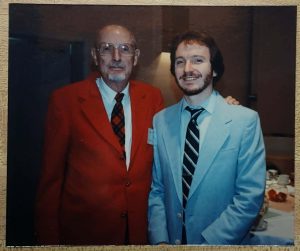
In two or three minutes — a few hundred seconds that meant far more to me than any other month, across the entirety of my master’s program — Dr. Nichols paid me and my research a few more nice compliments. Of course, the audience would nod in agreement with their founding father!
Then the moderator declared the session concluded, and, after a mild rush to the lectern, the fifteen copies of the paper disappeared in seconds, with people asking me why I hadn’t brought more! Could I please mail them a copy? I did do that, once back home in Maryland – this was Scottsdale, AZ. I couldn’t wait to tell all this to my beloved, speech-teaching grandma.
My first-ever scholarly presentation, of quite a few to come, had gone pretty dang well! By snail mail (this all happened before e-mail), I was asked if I would initiate and lead, for the International Listening Association, a new “graduate student committee” for their organization, of which a year’s paid membership had come as part of my prize.
That, I did, to the happy approval of my faculty at Maryland. They had not “bet wrong” in offering to pay me, for two-plus years, to study for my master’s degree there (not at Cornell University, my other suitor, as they knew well) .
Best of all, that really cemented my mentor-mentee relationship with Ralph Nichols. And it also put me in great stead among many of the most prominent authors in my new specialization.
It’s all about your thesis!
And those relationsips greatly bolstered the research I conducted for my master’s thesis, where I proposed and outlined (complete with hand-sketched graphic model — computers not yet available for graphic design!) a theory of “listening in organizations.”
One such kind scholar, Dr. Judi Brownell, indeed of Cornell University, even met me for an hour’s interview (as part of my research) at a truck stop near my dad’s home in Apalachin, NY, as she passed by the tiny town of Apalachin, on her way from Ithaca to a conference in NYC. All arrangements transpired by snail mail. And it all timed out to perfection, with lots of special and priceless information shared with me, amidst the clatter, heard loudly on my tape of our interview, of plates and glasses being bussed. Amazing.
If you’re curious, here’s the main “news” of my 80-page thesis, which wrapped up my studies at Maryland. Unlike settings of “intepersonal” communication, in the organizational setting (basically, “at work”), the “six nonverbal indicators of listening” mean very little. At work, it’s not head-nodding that makes one feel “listened to,” it’s the follow-up action that does or doesn’t happen. Words to the wise.
That, I argued, is what our listening literature is missing. When our corporate trainers (in-house or consultants) come in to provide communication training, their “listening” segments still focus on traditional material from the “interpersonal” arena. We are teaching “how to demonstrate the six indicators of listening” but missing the one indicator that matters most at work: follow-up!
Speaking of follow-up
At the following year’s (1989) ILA convention, I did serve (as I’d done all year, soliciting membership) as the chair of the newly-formed “Graduate Student Committee.” Dr. Nichols (aided, as always, by Lucile, ever so helpful to him and gracious to me) and I had even collaborated to put on a special session that I moderated, where fellow graduate students could personally meet and ask questios of The Father of Listening, himself. I believe (hard to verify) that this was his final appearance at the ILA conventions. Public speaking was becoming very difficult, by the time of that last appearance.
Talk about being at the right place at the right time. Thanks to a letter written, in some exhastion, at midnight, I had caught him just in time. Maybe it was mostly luck, and I do thank my lucky stars (and Heaven) for all of the above, including not getting my walkman stolen and my butt thrown onto the subway tracks — end of story.
And, speaking of our correspondence, in the letter I received from Dr. Nichols following that second convention, he shared that, in some ways, he thought of me as the son he had always wished for, one who would follow in his footsteps. Out of respect, I will hold off on any further details on that sentimental stuff, but those kind and encouraging words meant (and still mean) the world to me. Clearly and obviously, however, I knew I could never follow in those trail-blazing footsteps. Well, in my own way, maybe.
Another story
I have done my best, including now, for the first time, writing up this story for you. As I look back on all this, which I have loved putting into words for as the first post on this “Tales of Communication” slice of my new Up-Wordz.com website, I somehow wonder that, since he is considered “the father of listening,” I must belong somewhere on the family tree. Distant relative of listening? I’ll take it.
After graduating from Maryland with my MA in speech communication, I moved back out to my adopted home state of Colorado, and became a “speech teacher,” myself (at least, for career starters), at the Jesuit college in Denver, Regis University. Across thirty years there, I never stopped pushing, including special assignments and papers, the importance of listening.
Beyond that, I do try (if sometimes in vain) to practice what I preach. As Dr. Nichols knew and promoted, all his life, that’s the hard part. Writing about listening is one thing; doing it, well, that’s another story.